
By Raymond Ken-Mbata
ABUJA, September 11, 2026 – The Federal Government has moved to decriminalise attempted suicide in Nigeria, following the approval of the Federal Executive Council (FEC) for the position of the Federal Ministry of Health and Social Welfare on the matter.
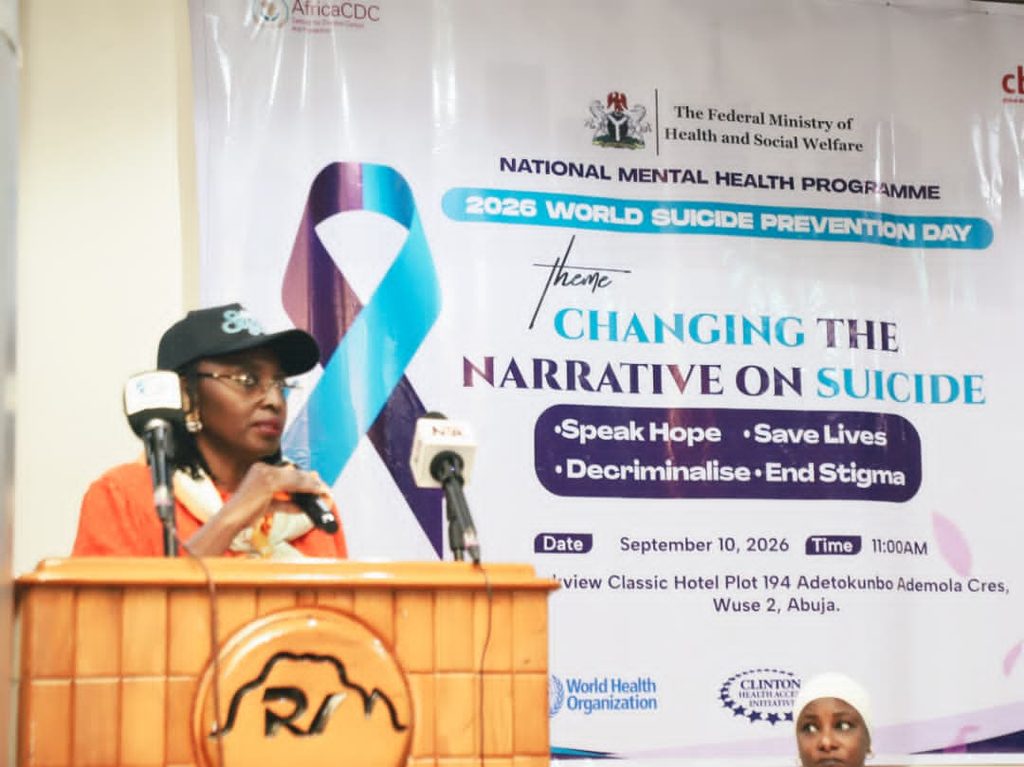
The Minister of State for Health and Social Welfare, Dr. Iziaq Adekunle Salako, disclosed this in Abuja on Thursday at an event marking the 2026 World Suicide Prevention Day. A statement signed by Ado Bako, Assistant Director, Information and Public Relations, Federal Ministry of Health and Social Welfare, on the 10th of September 2026, said the FEC approval would now allow the proposed reform to move to the National Assembly for the required legislative process.
Dr. Salako, who was represented by the Permanent Secretary of the Ministry, Ms. Daju Kachollom S., mni, said the proposed change was more than a legal matter, describing it as an important public health and human rights intervention. He said people who survive suicide attempts, particularly those experiencing mental health crises, should be able to access care and support without the added fear of criminal prosecution.
According to him, removing the criminal dimension could help reduce the stigma surrounding suicide attempts and make it easier for people in distress to seek help. He, however, cautioned that changing the law would not, on its own, solve the problem of suicide, stressing the need to expand mental health services, improve early detection and intervention, strengthen community support and sustain public education.
The Minister said the move was part of the Federal Government’s wider effort to strengthen mental healthcare under the Renewed Hope Agenda of President Bola Ahmed Tinubu, GCFR. He pointed to the National Mental Health Act 2021, National Mental Health Policy 2023 and National Suicide Prevention Strategic Framework 2023–2030 as key instruments guiding the country’s response.
Dr. Salako also disclosed that the Ministry had established a National Task Force on the Decriminalisation of Attempted Suicide, bringing together government agencies, academics, professional associations, civil society groups, development partners and people with lived experience. The task force has conducted consultations, engaged policymakers across the three arms of government and produced a Government White Paper to support the reform process.
Earlier, the Director of Public Health, Dr. Charles Nzelu, represented by the National Coordinator of NASCP, Dr. Adebobola Bashorun, said the Ministry was working to strengthen mental health services and integrate them into primary healthcare. Other areas highlighted included training for health workers, community-based interventions and stronger partnerships among stakeholders.
Dr. Nzelu said the decriminalisation process had involved legal experts, mental health professionals, civil society organisations, development partners, youth representatives and people with lived experience. He urged Nigerians to create a more supportive environment where people can discuss mental health difficulties and seek help without being judged or discriminated against.
Also speaking, Dr. Akanmu Mujitaba, Mental Health Programme Manager, Clinton Health Access Initiative, Nigeria, said suicide remained a major public health concern, with more than 700,000 people estimated to die from suicide globally each year. He cited World Health Organisation estimates of more than 7,000 suicide deaths and about 300,000 suicide attempts annually in Nigeria.
Dr. Mujitaba welcomed the FEC approval and commended the Ministry and the National Mental Health Programme for advancing the reform, while urging stakeholders to ensure that the process continues through the National Assembly to eventual legislative passage.
The development comes as Nigeria joins other countries to mark World Suicide Prevention Day, observed every September 10. The 2026 theme, “Changing the Narrative on Suicide,” places emphasis on moving away from silence, stigma and punishment towards conversations, support and timely intervention.
About the Author