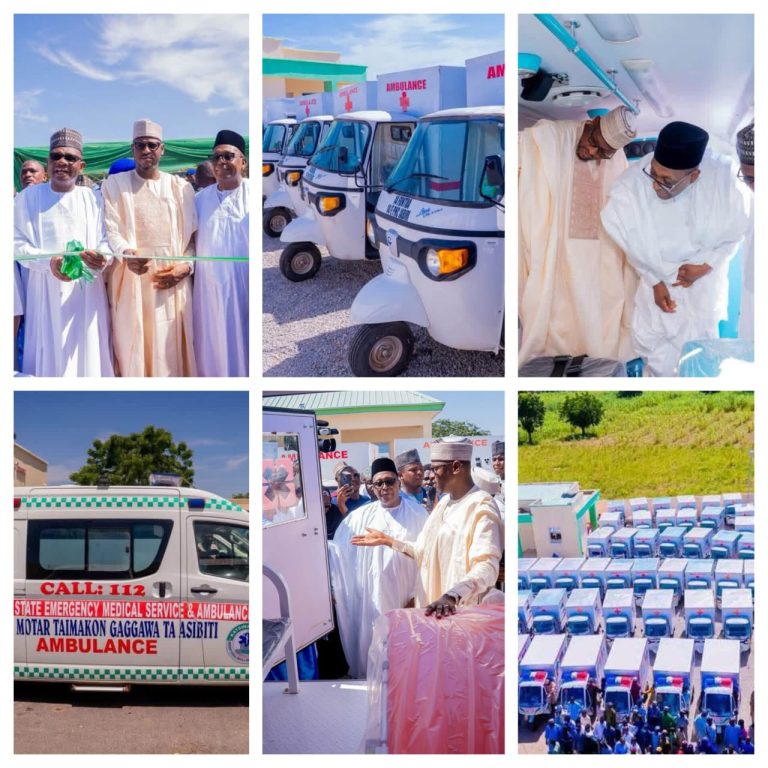

ABUJA, NIGERIA – Nigeria’s healthcare transformation drive received another major boost as President Bola Ahmed Tinubu unveiled, on Friday 29th of May 2026, a range of new health infrastructure projects across the country and introduced 145 tricycle ambulances to strengthen emergency medical services, particularly in underserved communities.
The initiatives, launched as part of activities marking the administration’s third year in office, cut across primary, secondary, and tertiary healthcare levels in all six geopolitical zones, reflecting ongoing efforts to improve healthcare delivery and ensure wider access to essential medical services.
Speaking during the commissioning ceremony, President Tinubu said the projects represent a significant step in the government’s broader plan to rebuild the nation’s health system and make quality healthcare more accessible to every Nigerian. He emphasized that healthcare services available within the country should be capable of meeting standards that previously compelled many Nigerians to seek treatment abroad.
The President also highlighted the importance of a coordinated national emergency response framework, stressing that emergency medical support must be readily available regardless of location—from remote rural settlements to densely populated urban centres.
He acknowledged the contributions of the Federal Ministry of Health and Social Welfare, the National Emergency Medical Service and Ambulance System (NEMSAS), the National Primary Health Care Development Agency, state governments, development partners, and teaching hospitals that played key roles in delivering the projects.
Coordinating Minister of Health and Social Welfare, Prof. Muhammad Ali Pate, noted that the investments align with Nigeria’s ambition to achieve Universal Health Coverage by 2030 under the Health Sector Renewal Investment Initiative. According to him, government efforts have focused not only on expanding infrastructure but also on strengthening disease prevention programmes, immunisation services, maternal healthcare, and primary healthcare delivery nationwide.
Minister of State for Health and Social Welfare, Dr. Iziaq Adekunle Salako, described the developments as another important milestone in efforts to bring lifesaving healthcare services closer to Nigerians. He announced the rollout of critical NEMSAS assets, including 145 tricycle ambulances, six boat ambulances, emergency dispatch systems, and communication equipment aimed at improving pre-hospital emergency care and patient transportation across the country.
Among the projects commissioned were Emergency Operations Centres in Kano, Sokoto, and Katsina States; the Lagos Vaccine Hub; upgraded primary healthcare facilities in Delta State; a new Trauma Centre at Ahmadu Bello University Teaching Hospital; a Mental Health Complex at the University of Maiduguri Teaching Hospital; an Infertility and Assisted Reproductive Technology Centre in Bauchi; a modern Laboratory Complex at the University of Uyo Teaching Hospital; and the President Bola Ahmed Tinubu Complex at a Federal Medical Centre.
Salako further disclosed that over 100 healthcare projects have been earmarked to commemorate the administration’s third anniversary. He added that recent reforms have resulted in significant gains, including a more than 33 percent increase in health insurance coverage, the revitalisation of over 4,000 primary healthcare centres, the establishment of 15 new federal tertiary health institutions, and the delivery of more than 500 specialised health facilities, including cancer treatment and diagnostic centres.
Permanent Secretary of the Federal Ministry of Health and Social Welfare, Daju Kachollom, explained that the newly deployed ambulances will support referral systems and emergency response services, especially in rural and hard-to-reach areas. She noted that trained drivers and healthcare personnel will accompany the ambulances to ensure timely medical intervention and improve patient outcomes.
Kachollom expressed optimism that ongoing reforms under the Renewed Hope Agenda would continue to strengthen healthcare delivery, while enhanced emergency communication networks are expected to improve coordination among healthcare facilities and speed up patient referrals nationwide.
The commissioning event attracted senior government officials, health sector leaders, development partners, and representatives of agencies under the Federal Ministry of Health and Social Welfare, underscoring the growing national focus on building a more resilient and responsive healthcare system.
Raymond Ken-Mbata reporting for Health Pharm Media
About the Author